Chimney scaffoldingwith a proper working platformat ridge height
A boarded, guarded platform at the right height so your chimney gets rebuilt, repointed, lined or removed properly in one visit — instead of a bricklayer straddling a wet roof trying to work off a ladder and a roof hook.
24 years in the trade · Free site visit · £10m public liability
- 24 years in the scaffolding trade
- CISRS-carded operatives on every job
- Gold Scaffolding Supervisor card
- £10,000,000 public liability insurance
- Free site visits and written quotes
Chimney scaffolding: what it is and when you need it
What the service is
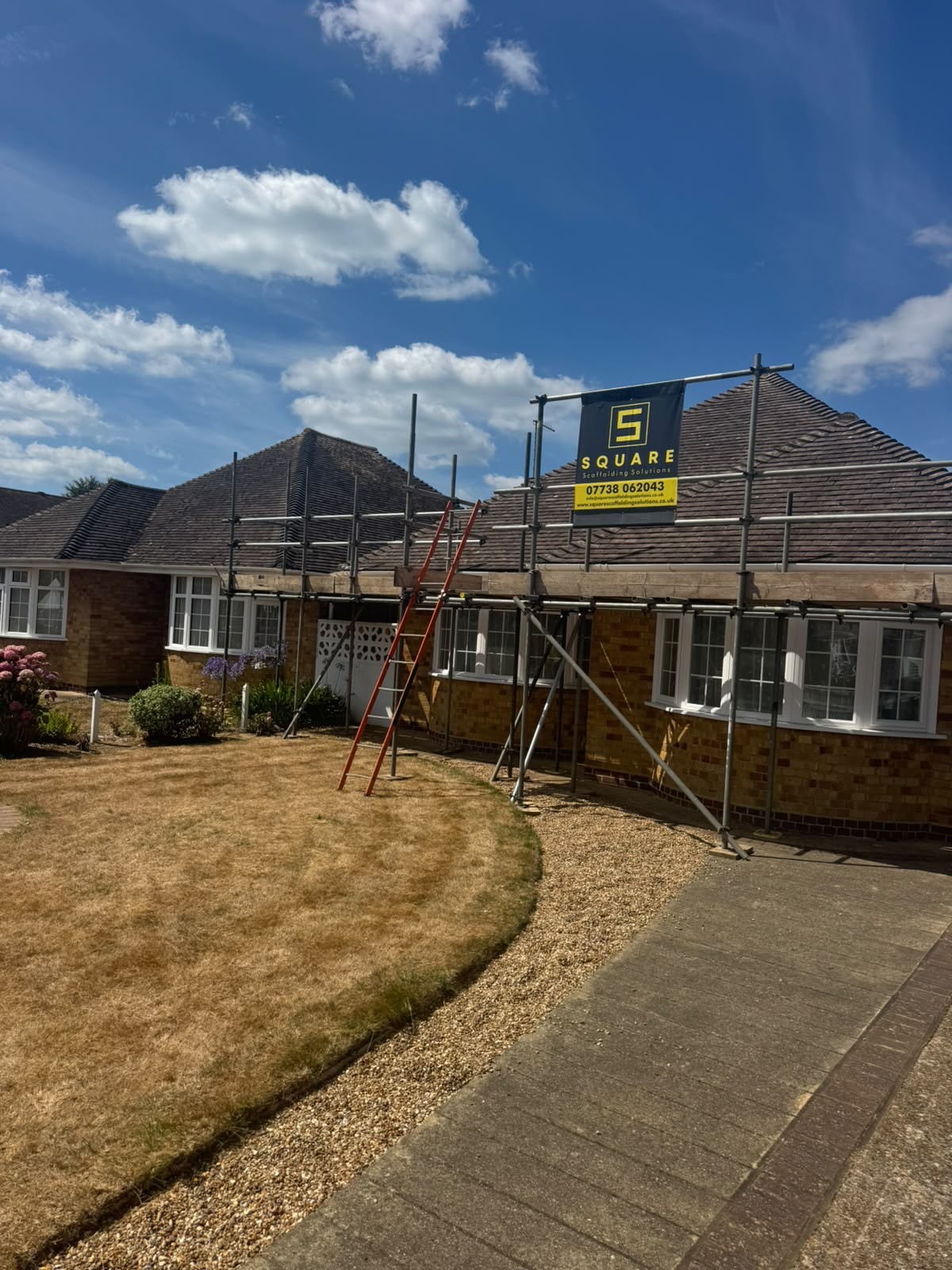
Chimney scaffolding is an access scaffold taken up the elevation and over the roof to form a boarded working platform around the stack, usually at or near ridge height. The platform surrounds the chimney so a bricklayer or roofer can work on all faces, with guardrails and toe boards, and with the roof covering protected beneath.
It is a specific discipline. The structure has to reach past the eaves, cross the roof slope without loading or damaging the tiles, and provide a stable, level deck at a height that suits the work — all while being tied properly into a building where the nearest solid tie point may be well below.
Who it is for
Homeowners with a failing stack, roofers and bricklayers carrying out chimney repairs, chimney and flue specialists installing liners and cowls, heating engineers commissioning wood burners and stoves, and surveyors inspecting stacks after storm damage or before purchase.
Older housing stock across Chichester, Arundel, Worthing and the Sussex villages produces a steady stream of chimney work — Victorian and Edwardian stacks with soft lime mortar, exposed to Channel weather for a century, eventually need attention.
When it is needed
The usual triggers are perished pointing and crumbling mortar, a leaning or cracked stack, failed flaunching or a loose pot, damp appearing in the chimney breast, lead flashing failure at the roof junction, installing a liner for a wood burner or stove, fitting a cowl or bird guard, or removing a redundant stack entirely.
Storm damage is the other common trigger. A stack that has moved or shed masonry needs access urgently, both to make it safe and to allow the repair.
Why professional help matters
A chimney is the most exposed masonry on the building — wind-driven rain on all faces, no protection from above beyond the flaunching, and constant thermal movement if a fire or boiler is in use. When the mortar goes, water gets into the stack and travels down into the roof space and the chimney breast.
Doing the work properly requires standing at it for hours with tools and materials to hand. That is not possible from a ladder or off roof hooks, and attempting it is how tiles get broken, work gets rushed, and people fall. A proper platform is what turns a bodge into a repair that lasts.
What it costs to get this wrong
Chimney problems escalate in a specific and expensive sequence. Pointing perishes, water enters the stack, and the damp travels down into the chimney breast — staining plaster and, over a winter or two, rotting the timbers around the stack in the roof space. What began as a repointing job becomes a rebuild plus internal repair plus redecoration.
The safety escalation is faster still. A stack with failed mortar is being held up largely by its own weight, and Sussex coastal gales test that assumption every winter. A leaning stack that could have been strapped and repointed in the autumn can end up on the roof — or worse, on a car, a conservatory or a person — by February.
Then there is the false economy of access. Trades who agree to work off a ladder or a roof ladder to save the customer the cost of a scaffold work slowly, cannot carry proper materials up, and inevitably damage tiles crossing the roof. The scaffold saving reappears as a roofing repair and a chimney that needs doing again in five years.
Mistakes we see most often
- Delaying repointing until the stack has moved, converting a repair into a rebuild.
- Letting a trade work off a ladder or roof hooks to avoid the cost of proper access.
- Ignoring damp on an internal chimney breast, which usually starts at the stack above.
- Removing a stack without considering the roof structure, flashing and remaining flues.
- Booking the bricklayer before arranging access, so their date gets wasted.
- Not protecting the roof covering, resulting in broken tiles and new leaks around the work.
Our process
How we run a chimney scaffolding job
- 01
Tell us what the chimney needs
Repoint, rebuild, liner, cowl, removal or inspection — the work determines the platform height and the size of the deck.
- 02
Free site visit and roof assessment
Billy checks the elevation, the roof pitch and covering, the ridge height, tie options and where the wagon can get to. No charge, no obligation.
- 03
Written quote for the access
A clear price covering the elevation scaffold, the crossing over the roof, the chimney platform, hire period and dismantle.
- 04
Erection with the roof protected
Our CISRS-carded team builds the access, protects the roof covering where the structure crosses it, and forms a fully boarded, guarded platform around the stack.
- 05
Handover, works, then dismantle
Handed over ready for your bricklayer or roofer, checked through the hire, then dismantled and cleared once the chimney work is signed off.
What you get
The difference it makes on your job
All four faces reachable
A platform around the stack means the pointing, flaunching, flashings and pot are all worked on properly rather than whichever side the ladder happened to lean on.
The job gets done once
Materials and tools stay at height, so the bricklayer works continuously and the repair is finished to a standard that lasts.
Your roof covering protected
Crossing the roof is planned and protected, so you are not paying a roofer to replace cracked tiles after the chimney is finished.
Safe work at the most exposed point
Guardrails, toe boards and a level boarded deck at ridge height — not roof hooks, ladders and improvisation.
Faster trade attendance
Most bricklayers and roofers will book a chimney job sooner when they know proper access will already be standing.
Fully insured and competently built
£10,000,000 public liability, CISRS-carded operatives and Gold Supervisor oversight, certificates on request.
Chimney scaffolding in detail: materials, methods and applications
How chimney access is built
The structure starts as a standard independent scaffold to the elevation nearest the stack, taken up to eaves level and tied into the building. From there it is carried over the roof — either on a properly supported crossing that spreads load away from the tiles, or by extending standards past the eaves and bridging — up to a boarded platform set around the chimney at a working height, generally just below the top of the stack.
Load spreading and roof protection are the critical details. Standards must not point-load slates or plain tiles, and crossings need to bear on rafters or spreader arrangements rather than the covering itself. Tie positions are planned for a structure that is tall relative to its base, particularly on exposed coastal and hillside properties.
- Independent tied elevation scaffold as the base structure
- Protected roof crossing that spreads load away from tiles and slates
- Fully boarded, guarded platform set around the stack at working height
- Guardrails and toe boards to all open sides of the platform
- Ladder access with gates through the lifts to the platform
- Debris netting or sheeting where masonry will be removed
Chimney works the platform supports
Repointing and re-flaunching are the most common: raking out perished mortar, repointing in an appropriate mix — lime-based on older, softer masonry — and renewing the flaunching that holds the pots. Partial and full rebuilds follow, where the stack is taken down to a sound course and rebuilt, usually reusing the original bricks on visible faces where they are salvageable.
The platform also serves flue lining and stove installation, pot and cowl replacement, bird guard fitting, lead flashing and soaker renewal at the roof junction, stack strapping and stabilisation, and full removal with the roof made good afterwards.
- Repointing, re-flaunching and general stack repair
- Partial and full chimney rebuilds
- Flue lining for wood burners, stoves and gas appliances
- Pots, cowls, terminals and bird guards
- Lead flashing, soakers and back gutter renewal
- Stack removal, capping and making good the roof
Older, listed and coastal properties
Sussex has a large stock of pre-1919 housing with soft brick and lime mortar, and those stacks need appropriate materials — cement-rich mortar on soft historic brick traps moisture and accelerates decay. Where a building is listed or in a conservation area, both the repair specification and the scaffold's tie method may need to avoid permanent fixings into historic fabric.
Coastal exposure at Bognor Regis, Selsey, East Wittering and Worthing accelerates mortar loss on the seaward faces of stacks, and increases wind loading on a tall, narrow scaffold. Both are planned for at the survey rather than discovered during erection.
Residential and commercial chimney access
The overwhelming majority of chimney work is residential — single stacks on houses and cottages, with the priority being a short, tidy hire and protection of the property and garden below.
Commercially, we provide access to stacks and flues on pubs, hotels, schools, churches and estate buildings, where several stacks may be worked in sequence and RAMS and handover documentation are usually required. Those are issued on request.
Related services
Where we provide this service
- Scaffolding Chichester
- Scaffolding Arundel
- Scaffolding Worthing
- Scaffolding Bognor Regis
- Scaffolding West Sussex
Back to the Square Scaffolding home page, see all scaffolding services, or book your free site visit.
Chimney scaffolding: frequently asked questions
How much does chimney scaffolding cost?
It depends on the height of the building, the pitch and covering of the roof, how far the stack sits from the eaves and how long access is needed. Billy will survey it free of charge and give you a written price.
Do I really need scaffolding just to repoint a chimney?
For anything beyond a brief inspection, yes. Repointing takes hours at the most exposed point on the building with tools and materials in hand. It cannot be done properly or safely from a ladder, and most competent bricklayers will insist on a platform.
How long does it take to put up?
A typical single-stack chimney scaffold on a two-storey house is often up within a day. We give you a firm expectation at the site visit so your bricklayer's date can be booked with confidence.
Will the scaffolding damage my roof tiles?
It should not. The crossing over the roof is planned to spread load away from the covering, and protection is used where the structure passes over it. This is one of the main reasons to use scaffolders who do chimney access regularly.
Can you get access to a chimney in the middle of a roof?
Yes. Central and ridge stacks are common and are reached by carrying the structure across the roof from the elevation scaffold, with proper load spreading and protection.
How long can we keep the chimney scaffold up?
Six weeks as standard unless we agree otherwise when quoting, which is normally far more than a chimney repair needs. Extensions can be arranged if the works run on.
Can you provide access for a chimney removal?
Yes — including debris netting or sheeting where masonry is coming down, and access for the roofer making the roof good afterwards.
My chimney has been damaged in a storm. Can you come urgently?
Ring Billy directly. Storm-damaged stacks are handled through our emergency service and you will get an honest answer about timescales rather than being put in a queue.
Are you insured for work at this height?
Yes. £10,000,000 public liability insurance, all operatives CISRS-carded, and a Gold Scaffolding Supervisor overseeing the work. Certificates on request.
Which areas do you cover for chimney scaffolding?
West Sussex, Hampshire, Surrey and East Sussex from our yard at Eastergate — including Chichester, Arundel, Bognor Regis, Littlehampton, Worthing and Horsham.
Get a proper platform around the stack and have the chimney done once
Free site visit, a written price, and access built so your bricklayer or roofer can work all the way round the chimney safely.
24 years in the trade · Free site visit · £10m public liability