Commercial scaffoldingfor contractors acrossWest Sussex and Hampshire
Programme-led access that lands on the date in your build schedule, adapts when the sequence changes, and comes with the RAMS and handover paperwork your principal contractor will ask for — priced from a proper site survey, not a guess.
Gold Scaffolding Supervisor · CISRS-carded operatives · RAMS and handover packs on request
- 24 years in the scaffolding trade
- Gold Scaffolding Supervisor card held by the owner
- All operatives CISRS-carded
- £10,000,000 public liability insurance
- Scaffolding Association members
Commercial scaffolding: what it is and when you need it
What the service is
Commercial scaffolding is access designed around a construction programme rather than a single task. It covers independent and tied scaffolds to commercial elevations, internal birdcages, loading bays, edge protection, temporary roofs, phased adaptations as the build progresses, and planned dismantle at handover.
The difference from domestic work is not the steel — it is the coordination. A commercial scaffold has to accommodate multiple trades in sequence, allow for deliveries and plant movements, satisfy the principal contractor's health and safety requirements, and change shape several times during the build without ever being unsafe or unavailable.
Who it is for
We work for main contractors, developers, shopfitters, roofing contractors, M&E firms, facilities managers, property management companies, churches and schools, and estate teams responsible for a portfolio of buildings.
Many of these clients came to us after being let down on dates by a larger firm. Our team is small enough that Billy knows every job personally and large enough to keep multiple commercial structures running and inspected.
When it is needed
Commercial access is typically needed for refurbishment and re-roofing, cladding and render systems, window replacement programmes, structural repairs, painting and maintenance cycles, shopfront works, and planned preventative maintenance.
The earlier we are involved, the better the outcome. Being brought in at tender or pre-start lets us plan lift heights around the actual trades, position loading bays where the telehandler can reach, and phase adaptations so nobody is waiting.
Why professional help matters
The Work at Height Regulations 2005 place duties on whoever controls the work. A scaffold that is incorrectly erected, inadequately tied, unlabelled or uninspected is a live liability for the principal contractor, not just the scaffolder.
Competent supervision is the control that matters. Billy holds a Gold Scaffolding Supervisor card and all operatives hold in-date CISRS cards, so the structure is erected and supervised by people whose competence is formally assessed and documented — and we can evidence it in your paperwork pack.
What it costs to get this wrong
On a commercial site, scaffolding failure is measured in programme days. If the scaffold is late, every following trade slides. If an adaptation takes a week to arrange, the roofers cannot start their next section. If the handover pack is missing, your client's health and safety adviser stops the works until it appears. None of those are structural failures — they are organisational ones, and they cost real money.
There is also the inspection trap. Scaffolds in use must be inspected at regular intervals and after anything that could affect stability. Where that record is not maintained, an HSE visit or a client audit becomes a serious problem, and the paperwork gap sits on your file rather than the scaffolder's.
The third and quietest failure is an underspecified structure. A scaffold priced to win the job, with the minimum boards, minimum ties and no loading position, slows every trade using it. The saving on the scaffold quote gets swallowed several times over in labour inefficiency that nobody itemises.
Mistakes we see most often
- Awarding the scaffold on price alone without checking insurance limits, card levels and association membership.
- Bringing the scaffolder in after the programme is fixed, so lift heights and bay positions have to be compromised.
- Assuming adaptations are included when they were never scoped or priced.
- Not requesting RAMS and handover documentation until the client's auditor asks for it.
- Ignoring loading requirements, then finding the structure is not rated for the materials being landed on it.
- Leaving no allowance in the programme for erection, adaptation and dismantle windows.
Our process
How we run a commercial scaffolding job
- 01
Enquiry and programme review
Send drawings, a scope or a site address with your intended dates. We look at what trades need access, when, and for how long.
- 02
Site survey and access planning
Billy attends site, checks ground bearing, tie options, plant and delivery routes, exclusion zones and public interfaces, and identifies where bays and adaptations will be needed.
- 03
Written quote and documentation
You get a clear price covering erection, hire, planned adaptations and dismantle. RAMS, method statements and insurance certificates are issued on request.
- 04
Erection to the agreed date
Our CISRS-carded team erects to the plan, ties and braces as designed, fits guardrails, toe boards and access, and installs bays or edge protection as scoped.
- 05
Handover, inspection and planned dismantle
The structure is handed over with a handover pack on request and kept inspected through the hire, with adaptations turned around promptly and dismantle booked to suit your completion date.
What you get
The difference it makes on your job
Programme certainty
Erection, adaptation and dismantle dates are agreed and met, so following trades are not stood down and your critical path stays intact.
Documentation on request
RAMS, method statements, handover packs and £10m public liability certificates supplied so your health and safety file is complete before anyone asks for it.
Competent, evidenced supervision
A Gold Scaffolding Supervisor card holder overseeing CISRS-carded operatives — competence you can point to in an audit.
Adaptations handled quickly
Sequence changed? Lift added? We turn adaptations around promptly rather than leaving a trade waiting on an unavailable subcontractor.
Structures priced for the real loads
Boarding, ties and loading positions specified for what will actually be landed and stored, not the minimum needed to win the quote.
One point of contact
You deal with Billy from tender to dismantle. No account handlers, no repeating the job every time you ring.
Commercial scaffolding in detail: materials, methods and applications
Structure types and materials for commercial work
Commercial elevations are typically accessed with independent tied scaffolds in steel tube and fitting, chosen for adaptability where openings, canopies, plant and cladding rails complicate a standard grid. Where the building is tall or heavily loaded, additional bracing, closer tie centres and heavier boarding arrangements are specified. Free-standing and buttressed structures are used where tying into the facade is not permitted — common on curtain walling and on listed frontages.
Beyond the elevation scaffold, most commercial jobs need one or more secondary structures: loading bays for landing materials at height, internal birdcages for ceilings and services, temporary roofs during structural work, and edge protection to flat roof perimeters for follow-on trades.
- Independent tied and free-standing/buttressed scaffolds
- Loading bays sized to the materials and plant in use
- Internal birdcage decks for ceilings, M&E and surveys
- Fully sheeted temporary roofs for weather-critical phases
- Roof edge protection and guardrail systems
- Debris netting, monoflex sheeting and public protection fans
Methods, phasing and public interface
Phasing is where commercial scaffolding is won or lost. On a re-roof, we often build to eaves for the strip, then adapt upward for the covering. On a render programme, lift heights get set to a comfortable working height for the applicator rather than to a nominal two metres. On window replacement across multiple floors, we plan the sequence so the installers move continuously rather than waiting for boards to be lifted.
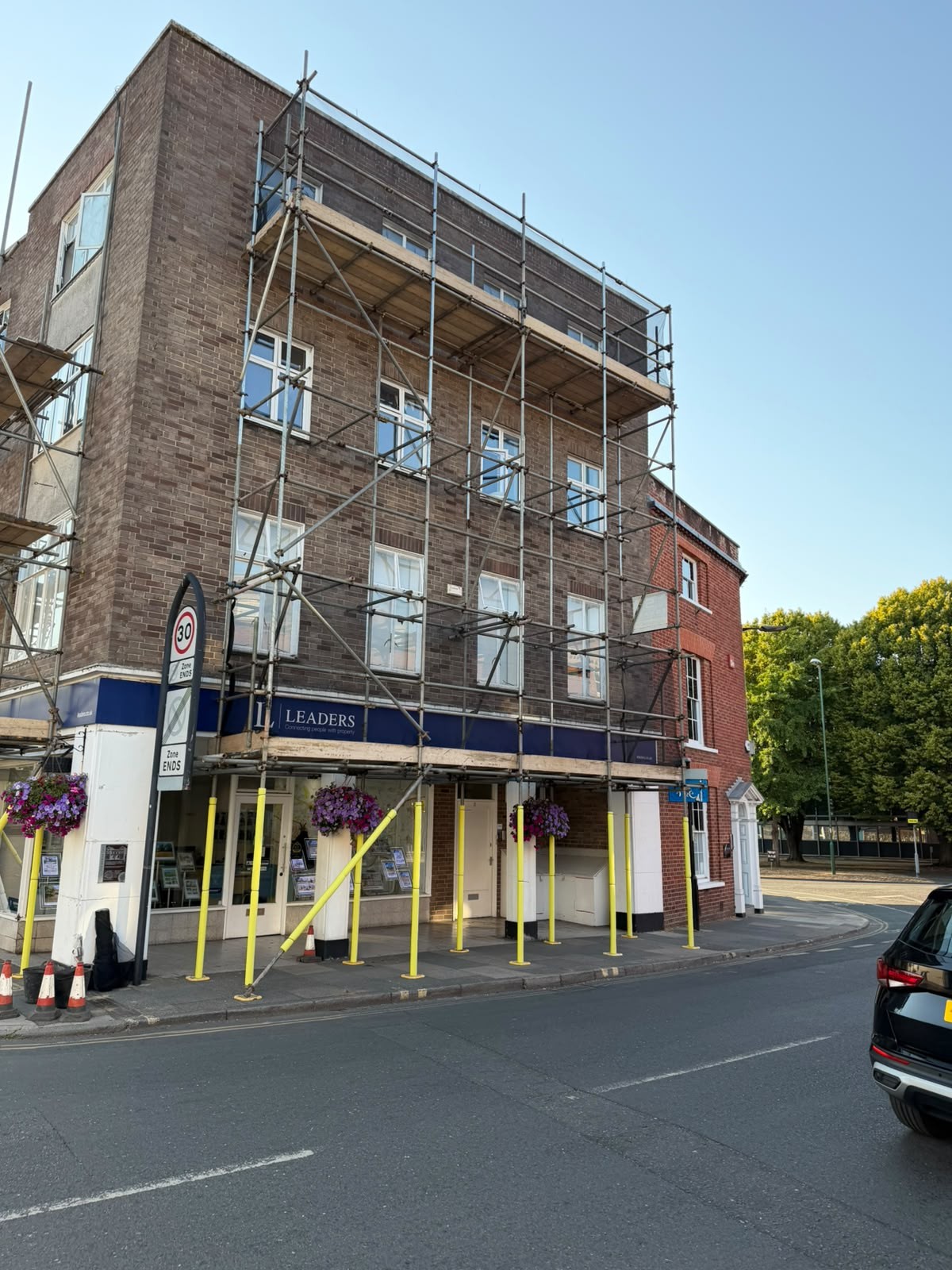
Town-centre sites bring a public interface: pedestrian routes, shopfronts trading through the works, and highway licences. Where the scaffold stands on the public highway or overhangs it, a licence from the highway authority is required, and protection fans, hoardings or covered walkways may form part of the arrangement. We plan these in rather than discovering them on the first morning.
Sectors and building types we work on
We provide commercial access across retail units and shopfronts, offices, schools and colleges, churches and listed civic buildings, care homes, hotels and guest houses, agricultural and equestrian buildings, light industrial units, and residential blocks under management.
Each brings its own constraint. Schools need work phased into holidays and strict segregation from pupils. Care homes need noise, dust and access managed around residents. Retail needs the shop trading. Churches and listed buildings need non-invasive ties and careful protection of historic fabric. The scaffold is the easy part; fitting it around how the building is used is the skill.
Commercial versus domestic: what actually changes
Commercial work carries formal documentation, inspection regimes, phased adaptations, coordination with a principal contractor's programme, and often out-of-hours or weekend erection windows. Loads are higher, structures are larger, and there is usually a defined interface with the public.
Domestic work is faster to mobilise and lighter on paperwork, but it demands more direct communication with the client and their neighbours. We run both from the same yard in Eastergate with the same team and the same standards.
Related services
Where we provide this service
- Scaffolding West Sussex
- Scaffolding Hampshire
- Scaffolding Surrey
- Scaffolding Portsmouth
- Scaffolding Horsham
Back to the Square Scaffolding home page, see all scaffolding services, or book your free site visit.
Commercial scaffolding: frequently asked questions
How much does commercial scaffolding cost?
It is driven by the size of the structure, height, duration, complexity of ties and access, and how many adaptations the programme needs. We survey the site, price the whole sequence including adaptations and dismantle, and put it in writing. Site visits and quotes are free.
Can you supply RAMS and a handover pack?
Yes. Risk assessments, method statements, handover packs and public liability certificates are issued on request and are standard on our commercial and contractor work.
How much public liability insurance do you carry?
£10,000,000, with certificates available on request for your pre-qualification or health and safety file.
Are your operatives qualified and supervised?
Every operative holds an in-date CISRS card and Billy Kelly holds a Gold Scaffolding Supervisor card. We are also members of the Scaffolding Association.
How quickly can you mobilise for a commercial job?
It depends on the scale and what is already booked, but you will get an honest date rather than an optimistic one. Ring Billy directly and he will tell you what is realistic for your programme.
What happens if our programme changes mid-build?
Tell us as early as you can and we will re-plan. Adaptations, additional lifts and extended hire are all normal on commercial work — the problem is only ever late notice, not the change itself.
How long is the hire period on commercial contracts?
Six weeks is our standard hire unless we agree a different period when quoting, which is common on longer commercial programmes. The agreed duration is stated in the quote.
Do you handle scaffolding on public highways and shopfronts?
Yes. Where the structure stands on or overhangs the public highway a licence from the local authority is needed, and protection fans or pedestrian routes may be required. We identify all of this at the survey.
Do you keep scaffolds inspected during the hire?
Yes. Structures in use are checked through the hire period and after events that could affect stability, and inspection records can be included in your documentation.
Which areas do you cover for commercial work?
We work across West Sussex, Hampshire, Surrey and East Sussex from our yard at Eastergate near Chichester, including Portsmouth, Worthing, Horsham and Littlehampton.
Put a scaffolder on your programme who hits the dates
Send us the drawings or the site address. Billy will survey it, price the full sequence including adaptations, and issue RAMS and handover documentation on request.
Gold Scaffolding Supervisor · CISRS-carded operatives · RAMS and handover packs on request