
Domestic scaffoldingin Chichester and acrossWest Sussex
Safe, tidy access outside your home — put up on the date we agree, priced in writing before we start, and taken down the day your builder finishes. Standard six-week hire, free site visit, and one number to ring if anything needs changing.
24 years in the trade · Free site visit and written quote · £10m public liability
- 24 years in the scaffolding trade
- CISRS-carded operatives on every job
- Gold Scaffolding Supervisor card
- £10,000,000 public liability insurance
- Free site visits and written quotes
Domestic scaffolding: what it is and when you need it
What the service is
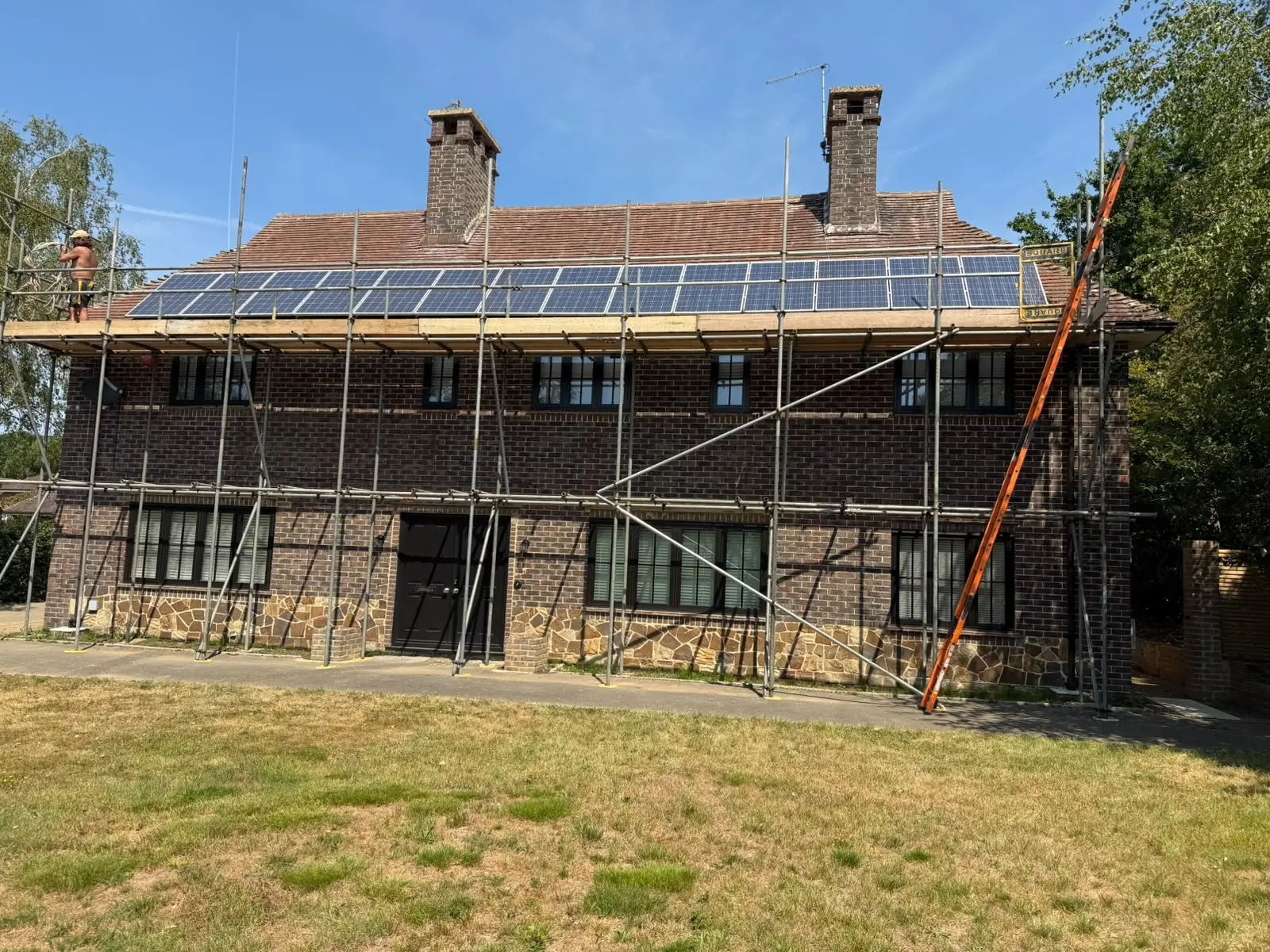
Domestic scaffolding is the temporary access structure that lets builders, roofers, renderers, painters and window fitters work safely on your house. It is a tube-and-fitting or system structure erected against the elevations being worked on, boarded out into working lifts, guarded with handrails and toe boards, and tied back into the building so it cannot move.
We design each domestic scaffold around the property in front of us rather than a standard drawing. A Victorian terrace in Chichester with a shared alleyway needs a different approach to a 1970s detached in Bognor Regis with a wide driveway, and a thatched or listed cottage in Arundel needs different protection again. The measurements, the lift heights, the tie positions and the ground conditions all get looked at before a price is written.
Who it is for
Most of our domestic clients are homeowners who have never hired scaffolding before, which is why the process is kept plain. You do not need to know what a putlog is or how many lifts you need — that is our job. Tell us what work is happening and we will work out the access.
We also work directly with builders, roofers, solar installers, chimney specialists and rendering firms who need reliable access for their own domestic customers. Several of our regular jobs come from trades who got tired of scaffolders who did not turn up.
When it is needed
Typical triggers are a re-roof, a single or double-storey extension, a loft conversion or dormer, rendering or repointing, fascia and soffit replacement, external painting, chimney works, solar panel installation, guttering, or storm repairs.
The right time to call is as soon as you have a rough start date from your builder. Booking early means the scaffold is standing when your trades arrive, rather than your project sitting idle waiting for access.
Why professional help matters
Working at height is the single largest cause of fatal injury in UK construction. Ladders and towers have their place for short, light tasks, but anything involving materials, tools, or hours of work at height needs a proper platform with guardrails.
A competent scaffold also protects your property. Badly placed standards crack paving; unprotected tie-ins damage render and pointing; an untied structure moves in a February gale. Our operatives hold in-date CISRS cards and Billy Kelly holds a Gold Scaffolding Supervisor card, so the structure is put up by people who are trained and assessed to do it.
What it costs to get this wrong
When domestic scaffolding goes wrong, it rarely goes wrong quietly. The most common failure is not a collapse — it is a scaffold that does not arrive. Your roofer has stripped nothing, your tiles are on order, the skip is booked, and you are ringing a number nobody answers. Every day of that delay costs you in stood-down trades, extended builder charges and, on a stripped roof, exposure to weather.
The second failure is a scaffold that is wrong for the work. Lifts set at the wrong height mean your renderer is reaching above shoulder level all day, which is slower and produces worse finish. A deck that stops short of the gable means the last two metres get done off a ladder, or not at all. A structure without a proper loading position means every tile and bag gets carried up by hand.
Then there is the neighbour problem. Scaffolding frequently needs to sit close to, over or on a boundary. Handled badly, that becomes a dispute halfway through your project. Handled properly — with a conversation before the wagon arrives — it is a non-event.
Mistakes we see most often
- Accepting a price quoted over the phone without anyone seeing the property, then getting variations added once the wagon arrives.
- Booking scaffolding last, after the builder, roofer and skip are already scheduled.
- Assuming the hire period is open-ended — then discovering weekly charges started the day it went up.
- Using a tower or ladders for a full re-roof to save a few hundred pounds.
- Not checking that the scaffolder is insured, or that operatives hold current CISRS cards.
- Failing to mention a conservatory, oil tank, sloping garden or shared drive until the day of erection.
Our process
How we run a domestic scaffolding job
- 01
Call or send the details
Give us the postcode, what work is being done and roughly when you need access. Two minutes on the phone with Billy usually covers it.
- 02
Free site visit and survey
Billy comes out, measures the elevations, checks ground conditions, boundaries, access for the wagon, drains, conservatories and planting. There is no charge and no obligation.
- 03
Written quote with the hire period stated
You get a clear written price covering erection, hire and dismantle, with the six-week standard hire period stated up front so nothing lands on you later.
- 04
Erection on the agreed date
Our own CISRS-carded team erects the scaffold, ties it in, boards and guards the lifts, and protects paving, planting and paths as we go.
- 05
Handover, then dismantle when you are done
The scaffold is checked and handed over ready to work on. When the trades are finished, ring us and we take it away cleanly. Need longer? Tell us early and we arrange an extension.
What you get
The difference it makes on your job
Dates you can plan around
We commit to an erection date and turn up on it, so your roofer, renderer or builder is not stood down at your expense.
A platform built for the actual work
Lift heights set to the task, decks that reach the gable, and a sensible loading position — so trades work at a comfortable height and finish faster.
Your property treated carefully
Paving, planting, drives and drainage are considered before the first standard goes down, and tie-ins are planned to avoid damaging render and pointing.
No surprise charges
Six-week standard hire is stated in the quote. If the project overruns, we agree an extension rather than letting charges accumulate silently.
Genuine peace of mind
£10,000,000 public liability cover, CISRS-carded operatives and Scaffolding Association membership — certificates supplied on request.
One person accountable
Billy prices the job, plans the structure and is on site while it goes up. No call centre, no being passed between departments.
Domestic scaffolding in detail: materials, methods and applications
Materials and how a domestic scaffold is put together
Most domestic work is built in traditional steel tube and fitting, which is the most adaptable option for houses that are rarely square, rarely level and often extended. Standards (the vertical tubes) are set on base plates and sole boards to spread load on soft ground, ledgers and transoms form the frame, and scaffold boards are laid to form the working deck. Guardrails and toe boards are fitted at every working lift, and the whole structure is tied into the building at set intervals so it cannot move away from the elevation.
Where the ground falls away — common on the Downs-side properties around Arundel and Findon — the base is stepped or adjustable bases are used so every standard sits plumb and loaded correctly. Where a scaffold has to bridge a conservatory, porch, bay window or oil tank, we beam over it rather than build a compromised structure around it.
- Steel tube and fitting for adaptable, irregular domestic elevations
- Base plates and sole boards to spread load on lawns, gravel and soft ground
- Through-ties, box-ties or anchor ties depending on the wall construction
- Boarded working lifts with guardrails and toe boards
- Debris netting or sheeting where dust or falling material is a concern
- Ladder access with gates rather than climbing the frame
Types of domestic scaffold we build most often
An independent tied scaffold is the standard arrangement for a re-roof or full elevation: two rows of standards standing free of the building, tied back for stability. A putlog scaffold, where transoms bed into the brickwork joints, is occasionally used on new masonry work. For a single gable, chimney or dormer, a smaller targeted structure is often the sensible and cheaper option.
Extensions usually need a scaffold that changes as the build does — a lower lift while blockwork goes up, an additional lift for the roof, then a small adaptation for fascias and guttering. We plan those adaptations into the quote where the build sequence is known, so nobody is waiting for a scaffolder mid-programme.
- Independent tied scaffolds for full elevations and re-roofs
- Gable-end and single-elevation scaffolds
- Chimney scaffolds with a boarded platform at ridge height
- Beamed structures spanning conservatories, porches and bay windows
- Temporary roof scaffolds for stripped or structurally altered roofs
- Edge protection for solar installations and flat roof works
Situations that need extra planning
Terraced and semi-detached houses in Chichester, Bognor Regis and Worthing often have no side access wider than a metre, so materials are carried through or craned over. We identify that at the survey stage rather than on the morning.
Listed buildings and conservation-area properties — of which there are plenty across Arundel, Petworth and central Chichester — usually need non-invasive tie methods so no permanent fixings go into historic fabric. Coastal properties around Selsey, East Wittering and Bognor need extra attention to tie frequency and sheeting, because wind loading on a sheeted scaffold near the sea is significant.
Where scaffolding must stand on a public footway or road, a licence from the local highway authority is required. We will tell you at the visit if that applies to your property and what it involves.
How domestic differs from commercial work
The engineering principles are identical; the priorities are not. On a domestic job, the scaffold sits outside somebody's home for weeks, so tidiness, noise, access to the front door, protecting the garden and speaking to neighbours matter as much as the structure. There is usually no site manager, so we communicate directly with you and your builder.
Commercial jobs bring formal paperwork, phased programmes and multiple trades. Domestic clients rarely need a full RAMS pack, but if your insurer, mortgage lender or a conservation officer asks for documentation, we can supply it. See our
Related services
Where we provide this service
- Scaffolding Chichester
- Scaffolding Bognor Regis
- Scaffolding Littlehampton
- Scaffolding Arundel
- Scaffolding Worthing
Back to the Square Scaffolding home page, see all scaffolding services, or book your free site visit.
Domestic scaffolding: frequently asked questions
How much does domestic scaffolding cost in West Sussex?
Price depends on the number of elevations, the height, ground conditions, access for the wagon and how long you need it. That is exactly why we do not quote blind over the phone. Billy visits, measures properly, and sends a written price covering erection, the hire period and dismantle — free of charge and with no obligation.
How long does it take to erect scaffolding on a house?
A single elevation or gable is commonly up within a few hours. A full wrap-around scaffold for a re-roof on an average detached house is usually a day. We confirm the expected duration at the site visit so you can tell your builder when access will be ready.
How long can I keep the scaffolding up?
Standard hire is six weeks unless we agree something different when quoting. That covers the vast majority of domestic projects. If your build overruns, ring us and we will arrange an extension rather than leaving you without access mid-job.
Do I need permission or a licence for scaffolding?
If the scaffold stands entirely within your own property, generally no. If it needs to stand on a public pavement or road, the local highway authority requires a licence. We will flag it at the site visit and explain what is needed for your address.
What happens if the scaffold needs to go over my neighbour's land?
You need your neighbour's agreement, and it is far easier to get before the wagon arrives than after. We identify overhang or boundary issues at the survey and are happy to explain the arrangement to neighbours directly — several of our reviews mention exactly that.
Will scaffolding damage my driveway, patio or garden?
It should not. Sole boards and base plates spread the load on soft ground and block paving, and we plan the layout around planting, drains, oil tanks and manholes. Anything vulnerable is identified at the site visit before we commit to a layout.
Is your scaffolding insured and are your scaffolders qualified?
Yes. We carry £10,000,000 public liability insurance, every operative holds an in-date CISRS card, Billy holds a Gold Scaffolding Supervisor card, and we are members of the Scaffolding Association. Certificates are available on request.
Can you come out urgently after storm damage?
Yes. Storm damage, slipped tiles and unsafe structures are handled through our emergency scaffolding service. Ring Billy directly and you will get an honest answer about what we can do and when — not a queue.
Do you cover my area?
We are based at JBS Yard in Eastergate, near Chichester, and work throughout West Sussex, Hampshire, Surrey and East Sussex — including Chichester, Bognor Regis, Littlehampton, Arundel, Worthing, Horsham and Portsmouth.
Who takes the scaffolding down and when?
We do, with our own team. When your trades have finished, give us a ring and we will book the dismantle. You are not left chasing a subcontractor to clear the structure off your drive.
Get your house scaffolded on a date you can actually plan around
Billy will visit, measure it properly and send a written price with the hire period stated. Free, no obligation, and you speak to the owner every time.
24 years in the trade · Free site visit and written quote · £10m public liability