Emergency scaffoldingacross Sussex and Hampshirewhen it cannot wait
Storm damage, a failed roof or an unsafe wall needs one thing first: a straight answer about what can be done and when. Ring Billy directly, describe what has happened, and you get a realistic response — not a queue, not a call centre, not a promise nobody intends to keep.
Speak to the owner directly · 24 years in the trade · £10m public liability
- Direct line to the owner, Billy Kelly
- 24 years in the scaffolding trade
- CISRS-carded operatives on every job
- £10,000,000 public liability insurance
- Scaffolding Association members
Emergency scaffolding: what it is and when you need it
What the service is
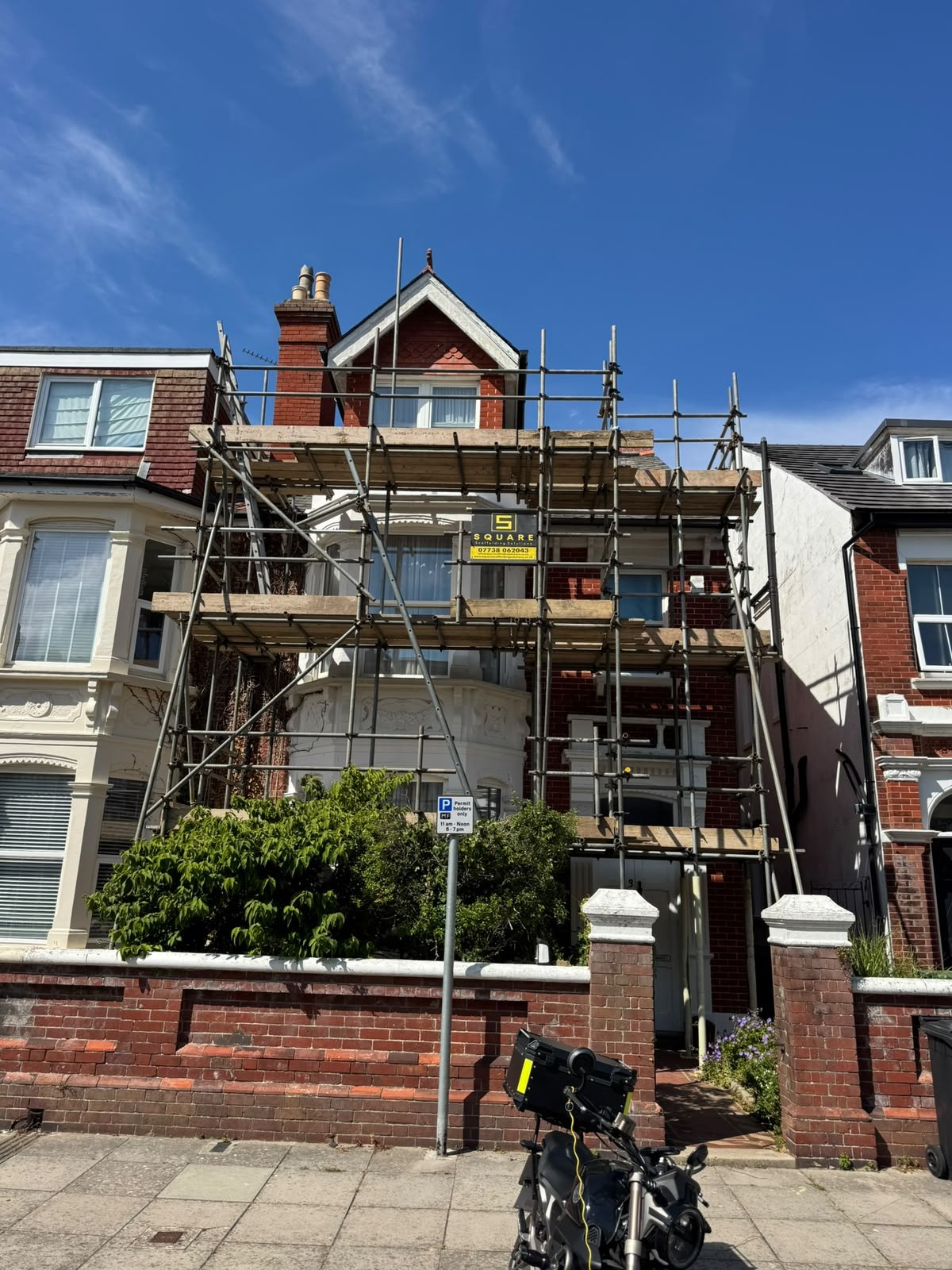
Emergency scaffolding is access and temporary support installed at short notice to make a damaged or unsafe building safe, and to allow urgent repairs to begin. That might be a scaffold to a storm-damaged roof, propping to a wall that has been struck or has moved, edge protection so a roofer can make a stripped roof safe, or a protective structure over a pavement where material is at risk of falling.
The purpose is different from planned work. A planned scaffold optimises for the programme; an emergency scaffold optimises for making the situation safe quickly and creating access so the repair can start.
Who it is for
Homeowners after a storm, letting agents and property managers with an unsafe building, insurers' contractors and loss adjusters needing access before assessment, commercial occupiers who cannot trade until a building is made safe, and builders who have opened something up and found more than expected.
We also get called by other trades — roofers, builders and surveyors — who need a scaffolder who will actually answer the phone on a Sunday afternoon in February.
When it is needed
Typical triggers are winter storms lifting tiles and ridge lines, wind or impact damage to chimneys, fallen trees on roofs and outbuildings, vehicle impact to walls, fire or flood damage, structural movement discovered during works, or a roof that has begun to leak badly and needs to be covered before further damage occurs.
The coastal strip between Selsey, Bognor Regis and Worthing takes the brunt of Channel storms, and the exposed properties along the Downs edge see the same. Most of our emergency calls follow a named storm by 24 to 48 hours.
Why professional help matters
Damaged structures deteriorate quickly, and they deteriorate fastest in exactly the weather that caused the damage. A partially lifted roof loses more covering with every gust. A cracked chimney stack sheds material onto whatever is beneath it. A wall that has moved once will move again.
There is also a duty of care. Where a building presents a risk to occupants, neighbours or the public, the owner or occupier is expected to take reasonable steps to control it. Getting a competent scaffolder to make the situation safe and document it is one of those steps.
What it costs to get this wrong
The cost of an emergency is rarely the initial damage — it is what follows. Twenty missing tiles is a modest repair. Twenty missing tiles left for a fortnight through a wet spell means soaked insulation, stained and blown ceilings, damp in the wall plates, tripped electrics and, in bad cases, rot in the roof timbers that were fine when the storm passed.
The same escalation applies structurally. A chimney that has shifted is dangerous but stable enough to be made safe today; left through another two storms, it becomes a demolition and rebuild rather than a repointing and strapping job, with the added risk of it coming down on a roof, a car or a person in the meantime.
And there is the access bottleneck. After a big storm, everyone is ringing everyone. The roofers who could fix your roof cannot start until there is safe access to it. The people who get repaired first are the ones who got a scaffold up first — which is why the phone call matters more than the paperwork in the first 48 hours.
Mistakes we see most often
- Climbing up to look at the damage personally, on wet tiles, in wind, off a domestic ladder.
- Waiting for an insurer to confirm cover before making the building safe, while damage continues to escalate.
- Accepting a tarpaulin thrown over a roof by a passing trader as a permanent solution.
- Leaving a damaged chimney or loose masonry above a pavement or shared access without protection.
- Not photographing the damage before work begins, which complicates the insurance claim later.
- Booking a scaffolder who cannot give a firm attendance time and then waiting on them for days.
Our process
How we run a emergency scaffolding job
- 01
Ring Billy and describe what has happened
You speak to the owner, not a call handler. Photos by message help enormously — send what you can safely take from ground level.
- 02
Honest assessment of what we can do and when
You get a realistic attendance answer straight away. If we cannot get there when you need us, we will say so rather than string you along.
- 03
Attend, assess and make safe
We look at the damage, decide what access or support the situation needs, and get the immediate risk under control — including propping or protection where required.
- 04
Erect access for the repair
A properly boarded, guarded scaffold goes up so your roofer, builder or surveyor can work safely and start the actual repair without delay.
- 05
Stay in place, then dismantle on completion
The structure stays and is checked while the repair proceeds, and comes down once you are finished. Documentation can be supplied for insurers on request.
What you get
The difference it makes on your job
A straight answer immediately
You find out within one phone call whether we can help and when — so you can act, rather than wait on a callback that never comes.
Damage stops escalating
Getting access and protection in place quickly is what stops a roof repair turning into a ceiling, insulation, electrical and decoration claim.
Your repair trade can start
Roofers and builders cannot begin without safe access. Getting the scaffold up first is what moves you up their list.
Risk to people is controlled
Falling material, unsafe walls and exposed openings are made safe with propping, protection and exclusion where needed.
Insurance-friendly documentation
£10m public liability certificates and job documentation can be supplied on request to support your claim.
Someone accountable throughout
Billy handles the job personally from the first call to dismantle. One number, one person, no handoffs.
Emergency scaffolding in detail: materials, methods and applications
What emergency work typically involves
The most common emergency call is storm damage to a roof: lifted or missing tiles, a displaced ridge, damaged leadwork or a section stripped by wind. The response is an access scaffold to the affected elevation, often with edge protection at the eaves, so a roofer can get up and make the covering good. Where large areas are open, a sheeted temporary roof may be the better answer, keeping the building dry while the repair is scheduled properly.
The second category is structural: a chimney that has cracked or shifted, a gable that has moved, an impact to a wall, or a floor or opening that has become unsafe. Here the priority is temporary support — propping and shoring — before anyone works on or near it.
- Access scaffolds to storm-damaged roofs and elevations
- Temporary roofs and sheeting over open or stripped roof areas
- Propping and shoring to walls, openings and floors
- Chimney access and protection where masonry is unstable
- Protection fans and exclusion where material could fall to a public area
- Access for surveyors, loss adjusters and structural engineers to inspect
Working with insurers and their contractors
A large share of emergency scaffolding sits inside an insurance claim. Insurers generally expect the policyholder to take reasonable steps to prevent further damage, and scaffolding to make a building safe is usually part of that. Photograph the damage before work starts where it is safe to do so, keep the paperwork, and notify your insurer as early as you can.
We work alongside insurers' appointed contractors, loss adjusters and building surveyors, providing the access they need to inspect and reinstate. Public liability certificates and job documentation are available on request for the claim file.
Residential, commercial and public-facing situations
On homes, the priority is usually the family: making the property safe to live in, getting the roof covered and getting the repair moving. On commercial premises, the driver is often trading — a retail unit or office that cannot open until the frontage or roof is made safe loses revenue every day.
Where a damaged building fronts a pavement, shared access or car park, the situation changes again. Falling masonry above a public area needs protection or exclusion immediately, and where a structure stands on the public highway a licence from the highway authority applies. We will tell you what is needed for your specific situation.
What we cannot promise
We are a small, owner-led team of experienced scaffolders, not a national network with wagons sitting idle. What that buys you is that Billy answers the phone and tells you the truth about timescales; what it means is that in the 48 hours after a major named storm, demand across Sussex and Hampshire is exceptional.
We would rather give you an honest date and let you make an informed decision than take the booking and let you down. That approach is why a large proportion of our work comes from repeat customers and recommendations from other trades.
Related services
Where we provide this service
- Scaffolding Chichester
- Scaffolding Bognor Regis
- Scaffolding Worthing
- Scaffolding Littlehampton
- Scaffolding West Sussex
Back to the Square Scaffolding home page, see all scaffolding services, or book your free site visit.
Emergency scaffolding: frequently asked questions
How quickly can you get to an emergency?
Ring Billy on 07738 062043 and you will get an honest answer immediately based on what is already booked and where the job is. We would rather tell you straight than promise an attendance we cannot make.
What should I do before you arrive?
Keep people away from the affected area, do not go up to inspect it yourself, and photograph the damage from ground level if it is safe to do so. Those photos are useful both to us and to your insurer.
How much does emergency scaffolding cost?
It depends on what the situation needs — access to one elevation, a temporary roof, or propping and support. We price it properly rather than inflating it because it is urgent, and site visits and quotes remain free.
Will my insurance cover it?
Many buildings policies cover reasonable steps to prevent further damage, but cover varies. Notify your insurer as early as you can, keep the documentation, and we can supply our public liability certificate and job paperwork for the claim file on request.
Can you prop an unsafe wall or opening as well as provide access?
Yes. Propping and temporary support are part of what we do, and on emergency work they are frequently needed before any other work can start safely.
Can you cover an open roof to stop water getting in?
Yes — either with sheeting or, where the opening is large or the repair will take time, a full sheeted temporary roof so the building stays dry while it is put right.
How long will the emergency scaffold stay up?
Until the repair is complete. Our standard hire is six weeks unless we agree otherwise, and extensions are arranged where a repair takes longer — which is common when insurers are involved.
Do you work with insurers' contractors and loss adjusters?
Regularly. We provide the safe access needed for inspection, assessment and reinstatement, and coordinate with whoever is appointed to carry out the repair.
Are you insured for emergency work?
Yes — £10,000,000 public liability, CISRS-carded operatives and a Gold Scaffolding Supervisor overseeing the work. Certificates available on request.
Which areas do you respond to?
West Sussex, Hampshire, Surrey and East Sussex from our yard at Eastergate near Chichester — including Bognor Regis, Littlehampton, Arundel, Worthing, Portsmouth and Horsham.
Ring Billy now and get a straight answer about your emergency
Describe what has happened and you will be told honestly what we can do and when. Photos by message help. No call centre, no queue.
Speak to the owner directly · 24 years in the trade · £10m public liability