
Temporary roof scaffoldingthat keeps the weather outof your project
A fully sheeted temporary roof over the works means the strip happens on your date, the trades keep working through the rain, and the finished plaster, joinery and insulation below stay dry — instead of your programme being rewritten every time the forecast turns.
24 years in the trade · Free site visit · £10m public liability
- 24 years in the scaffolding trade
- CISRS-carded operatives on every job
- Gold Scaffolding Supervisor card
- £10,000,000 public liability insurance
- Free site visits and written quotes
Temporary roofs: what it is and when you need it
What the service is
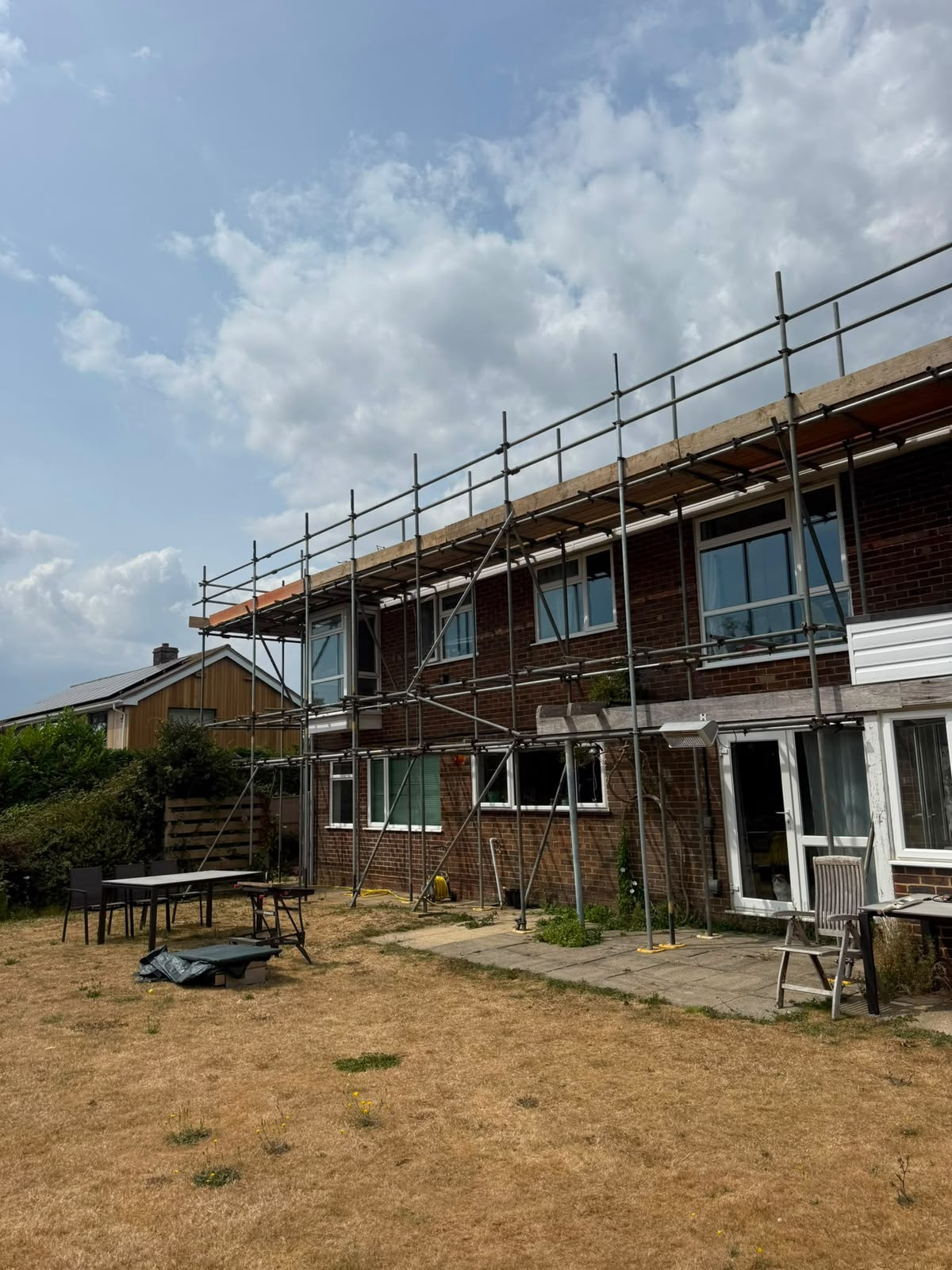
A temporary roof is a scaffold-supported, fully sheeted structure built over a building so work can continue underneath in any weather. Aluminium beams span the building and are supported on the perimeter scaffold, with a sheeted covering — typically a keder or corrugated sheet system — forming a weathertight envelope above the works.
The result is a covered, protected working area. The existing roof can be completely stripped, timbers replaced, structure altered or fire damage reinstated, without the building being open to the sky at any point.
Who it is for
Homeowners re-roofing or converting a loft, builders and roofing contractors running weather-critical phases, insurers' contractors reinstating fire and water damage, conservation specialists working on listed and heritage buildings, and commercial clients refurbishing occupied premises.
It is particularly common on the exposed coastal strip between Selsey, Bognor Regis and Worthing, and on older, high-value properties where the interior cannot be allowed to get wet.
When it is needed
Any time the roof covering comes off and cannot go straight back on: full re-roofs, structural timber repairs, dormer and loft conversions, chimney removals, fire or storm damage reinstatement, and re-leading or re-slating on historic buildings.
It is also worth it whenever the programme is tight or the season is wrong. Between October and March in Sussex, a temporary roof frequently pays for itself in avoided delay alone.
Why professional help matters
A stripped roof left under tarpaulins is a gamble on the forecast. Tarps lift and tear in wind, water finds the laps, and ceilings, insulation, electrics and plaster below get damaged — often costing more to put right than the temporary roof would have cost.
There is also a safety dimension. A properly engineered temporary roof gives the trades a defined, guarded working area over the opening. Working on an open, wet roof structure in wind with no covering is where accidents happen.
What it costs to get this wrong
Once tiles or slates come off, the clock starts. Felt is not a weatherproof layer, and on older buildings there may be no sarking at all. A single wet night through an open roof can soak insulation, stain plaster, wet electrical fittings and swell joinery. On a converted loft with new plasterboard already installed, that is a rip-out and a redecoration on top of the original scope.
The less obvious cost is the stop-start. Without cover, roofers work in short windows and re-sheet the roof with tarps every evening. Half of each day gets spent covering and uncovering, and any forecast of persistent rain means nobody attends at all. A three-week roof turns into six, with the scaffold hire and the builder's preliminaries running the whole time.
Then there is the insurance angle. Where damage occurs to the interior because the building was left inadequately protected, arguments about liability follow. A sheeted temporary roof removes that argument entirely — the building was covered.
Mistakes we see most often
- Relying on tarpaulins and battens for a multi-week roof strip, especially between autumn and spring.
- Booking the temporary roof only after the first weather event has already caused damage.
- Underestimating the span needed and trying to cover only part of the works.
- Ignoring wind loading on exposed coastal sites, where a sheeted structure catches significant load.
- Not planning material handling and access under the temporary roof, so the working area becomes congested.
- Leaving no allowance in the programme for erecting the roof before the strip begins.
Our process
How we run a temporary roofs job
- 01
Discuss the works and the programme
Tell us what is being done to the roof, the intended strip date and how long the structure needs to stay covered.
- 02
Free site visit and span survey
Billy measures the building, assesses the span, the support scaffold, the tie options and the exposure of the site, and checks access for delivering beams.
- 03
Written quote for the whole arrangement
One clear price covering the perimeter scaffold, the beams, the sheeting, the hire period and the dismantle — no charge for the visit or the quote.
- 04
Erection and sheeting
The support scaffold goes up first, beams are landed and secured, and the covering is sheeted and tensioned so the works below are enclosed and weathertight.
- 05
Checked through hire, then dismantled
The structure and sheeting are checked through the hire period, particularly after high winds, and taken down once your roof is complete and watertight.
What you get
The difference it makes on your job
Work continues in any weather
Trades attend and work full days regardless of rain, so the programme runs on the plan rather than the forecast.
The interior stays dry
Plaster, insulation, electrics, joinery and flooring below are protected, avoiding remedial work that often exceeds the cost of the roof itself.
A safer working area at height
A defined, covered, guarded platform over the opening instead of trades working on an exposed, wet roof structure.
No daily sheet-and-unsheet
Hours are spent building the roof, not covering and uncovering tarpaulins twice a day for weeks.
Protection for heritage fabric
Listed and period buildings get a controlled, dry environment for re-leading, re-slating and structural timber repairs.
Fully insured and competently built
£10,000,000 public liability cover, CISRS-carded operatives and Gold Supervisor oversight, with certificates available on request.
Temporary roofs in detail: materials, methods and applications
How a temporary roof is built
The support scaffold is erected first, taken high enough to carry the beams clear of the existing ridge. Aluminium beams then span the building, spaced according to the span and the expected loading, and are secured to the supporting structure. The covering is installed over the beams — either a keder-type sheeting system running in tracks or a corrugated sheet system — and tensioned so water runs off cleanly to the perimeter rather than pooling.
Because a sheeted roof behaves like a sail, tie frequency, bracing and anchorage are all increased relative to an open scaffold. That matters especially on the coastal strip around Selsey, East Wittering, Bognor Regis and Worthing, where sustained onshore wind is routine through winter.
- Perimeter support scaffold designed to carry the roof loads
- Aluminium roof beams spanning the building at calculated centres
- Keder or corrugated sheeting to form the weathertight envelope
- Increased ties and bracing to resist wind uplift
- Gable sheeting and end closures where full enclosure is required
- Access lifts and loading positions planned under the covered area
Variations and options
Not every job needs a full-span enclosed roof. On smaller works, a partial cover over a single slope, a monopitch arrangement, or a temporary roof over just the section being opened is often the right answer and costs considerably less. Where a building is being fully reinstated after fire, a fully enclosed structure with sheeted gables gives a controlled environment for drying and rebuilding.
Ridge height, span, pitch and whether the ends are sheeted are all decisions made at the survey. We size the arrangement around what is actually being done underneath rather than defaulting to the largest structure available.
- Full-span enclosed temporary roofs for complete re-roofs
- Monopitch and partial covers for single-slope works
- Sheeted gable ends for full enclosure and drying environments
- Temporary roofs over structural alterations and steel installations
- Fire and flood reinstatement enclosures
- Heritage and listed building protection with non-invasive ties
Residential and commercial applications
On residential properties, temporary roofs are most often used for full re-roofs, loft conversions where the roof is opened up for dormers, and reinstatement work after storm or fire damage. The priority is protecting the family's home and belongings while the building is open.
On commercial and industrial buildings, the driver is usually continuity — keeping a school, care home, warehouse or retail unit operating while the roof above is replaced. That means phasing the enclosure across sections of the building and coordinating with the occupier's routine, which we plan in at the survey stage.
How long a temporary roof stays up
Hire runs on the same basis as our other work: six weeks as standard unless a different period is agreed when quoting. Roof projects with structural work involved frequently need longer, so we usually agree a specific duration up front rather than defaulting.
If the works overrun — which happens most often when opening up reveals unexpected timber decay — tell us early and we will extend rather than leave a partially completed roof exposed.
Related services
Where we provide this service
- Scaffolding Chichester
- Scaffolding Bognor Regis
- Scaffolding Worthing
- Scaffolding West Sussex
- Scaffolding Hampshire
Back to the Square Scaffolding home page, see all scaffolding services, or book your free site visit.
Temporary roofs: frequently asked questions
How much does a temporary roof cost?
It depends on the span, the height, whether the ends need sheeting and how long it is needed for. It is a larger structure than a standard scaffold, so it is priced from a proper survey — which, like all our visits and quotes, is free.
Is a temporary roof really worth it for a domestic re-roof?
If the roof will be open for more than a few days, or the work is happening between autumn and spring, it usually pays for itself. Water damage to ceilings, insulation and decoration frequently costs more than the temporary roof would have.
How long does it take to erect?
The support scaffold goes up first, then the beams and sheeting. Duration depends on the size of the building — we give you a realistic figure at the site visit so it can be slotted into your programme before the strip date.
Will it hold up in strong wind?
A sheeted roof carries significant wind load, so ties, bracing and anchorage are increased accordingly, and structures are checked through the hire period — particularly after high winds. This matters on exposed coastal sites and we plan for it.
Can you cover only part of a roof?
Yes. Monopitch covers, partial spans and single-slope arrangements are common and often the sensible option where only one section is being opened up.
Can the building stay occupied underneath?
In most cases yes, which is one of the main reasons to have one. We plan the arrangement around how the building is used, whether that is a family home, a school or a care home.
How long can we keep the temporary roof up?
Six weeks is our standard hire unless we agree otherwise when quoting, and longer periods are common on structural roof works. Extensions can be arranged if the job overruns — just tell us early.
Do you provide temporary roofs for fire and flood reinstatement?
Yes. We work with homeowners and insurers' contractors to enclose damaged buildings so drying and reinstatement can proceed in a controlled, protected environment.
Can you install one urgently after storm damage?
Speak to Billy directly. Storm and impact damage is handled through our emergency service and you will get an honest answer about timescales rather than a queue.
Which areas do you cover?
West Sussex, Hampshire, Surrey and East Sussex, from our yard at JBS Yard, Eastergate — including Chichester, Bognor Regis, Littlehampton, Arundel and Worthing.
Keep the rain off the job and the programme on the plan
Billy will survey the span, price the whole arrangement in writing and tell you honestly whether a full or partial cover is the right call. Free visit, no obligation.
24 years in the trade · Free site visit · £10m public liability