
Roof edge protectionfor roofing, solar andmaintenance teams
Compliant guardrails and edge scaffolds installed to the perimeter so your team works to the edge confidently, the job passes a site inspection, and nobody has to argue about whether the access arrangement is adequate.
Gold Scaffolding Supervisor · CISRS-carded operatives · RAMS on request
- 24 years in the scaffolding trade
- Gold Scaffolding Supervisor card held by the owner
- All operatives CISRS-carded
- £10,000,000 public liability insurance
- RAMS and handover packs on request
Roof edge protection: what it is and when you need it
What the service is
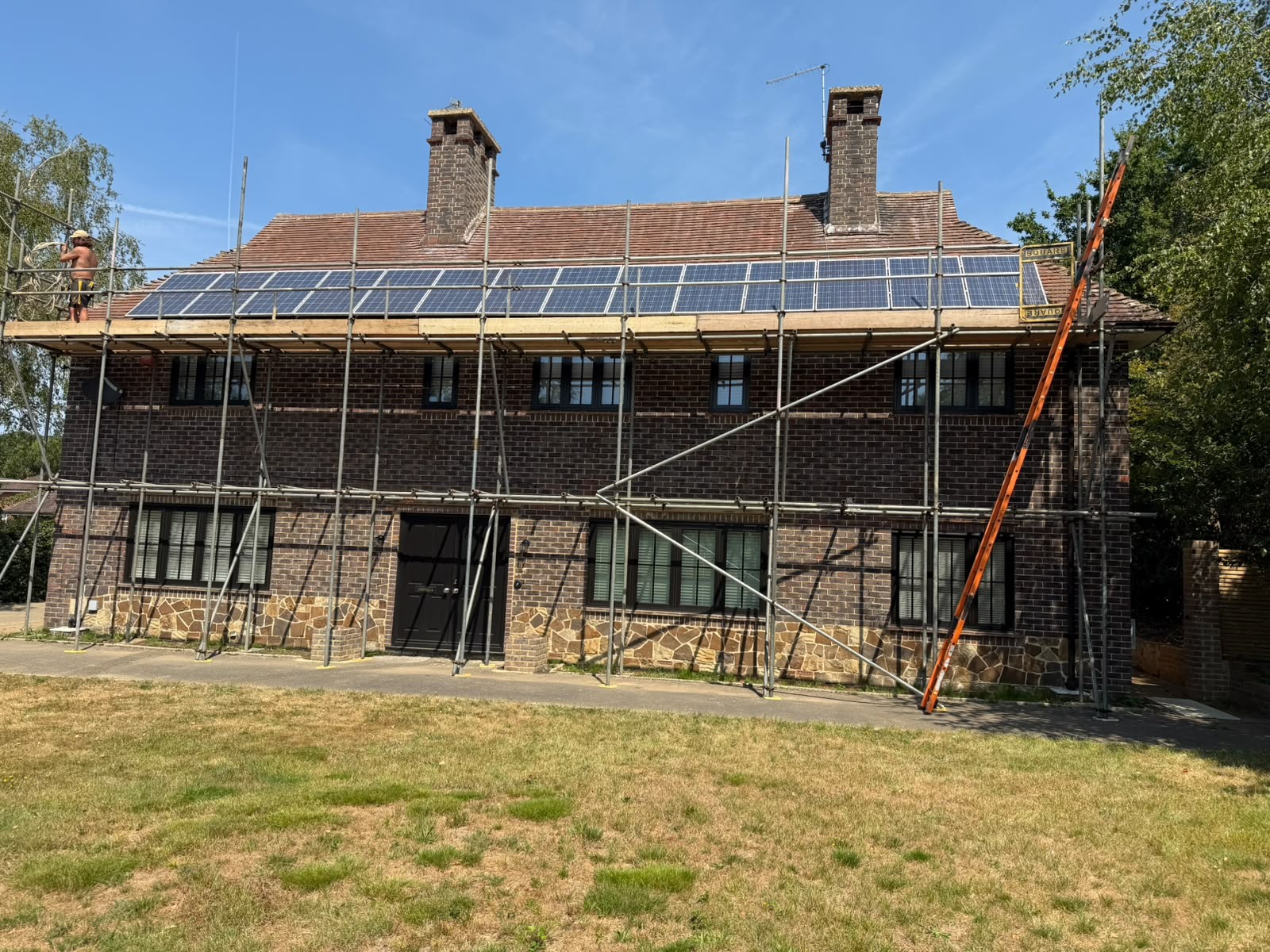
Roof edge protection is a physical barrier installed at the perimeter of a roof to prevent people and materials falling from the edge. On flat roofs it is typically a guardrail system with a top rail, intermediate rail and toe board; on pitched roofs it is usually an edge scaffold with a boarded platform and guarding set just below eaves level to catch a slip.
It is a collective protection measure, meaning it protects everyone on the roof at once without depending on individuals wearing, connecting and using equipment correctly — which is why the Work at Height hierarchy puts it above personal fall arrest.
Who it is for
Roofing contractors, solar PV installers, flat roof and single-ply specialists, gutter and fascia teams, facilities and maintenance managers, M&E contractors accessing rooftop plant, and surveyors inspecting roofs.
Solar installation has become one of the most frequent reasons for edge protection across West Sussex and Hampshire, on both domestic roofs and commercial and agricultural buildings.
When it is needed
Whenever anyone will work on or near a roof edge: re-roofing and recovering, flat roof replacement, solar panel installation and maintenance, rooftop plant servicing, gutter and fascia works, roof inspections and surveys, and cleaning or coating works.
It is also frequently required as a condition of a principal contractor's or client's site rules before any roof access is permitted at all.
Why professional help matters
Falls from height remain the biggest single cause of fatal injury in UK construction, and roof edges are where a large share of them happen. A moment of distraction, a wet membrane, a gust of wind or a misjudged step at the perimeter is all it takes.
There is a compliance dimension too. Where a job is inspected — by a principal contractor, a client's safety adviser or the HSE — inadequate edge protection is one of the fastest routes to work being stopped. Getting it installed properly by a competent scaffolder is cheaper than a shutdown.
What it costs to get this wrong
The most common failure is not the absence of edge protection but the assumption that harnesses cover it. Personal fall arrest depends on a suitable anchor point that actually exists, on a person clipping on every time, on the lanyard being short enough, and on there being sufficient clearance below. On a typical two-storey roof, several of those assumptions fail, and a fall arrest system that stops someone two metres above the ground is not doing its job.
The second failure is the stopped job. A roofing crew arrives, the client's safety adviser looks at the perimeter, and nobody is going up. The crew leaves, the programme slips a week, and the scaffolding gets arranged in a hurry at a worse price than if it had been planned. Every party loses money over an arrangement that should have been sorted at quotation stage.
The third is falling material. Edge protection is not only about people. Without a toe board, a dropped tile, tool or roll of membrane goes straight over the edge onto whatever is below — a car park, a pavement, a garden or a colleague. That is where public liability claims come from.
Mistakes we see most often
- Relying on harnesses and lanyards without a suitable anchor point or adequate fall clearance.
- Fitting edge protection to only part of a perimeter, leaving a gap where the work actually happens.
- Omitting toe boards, so material can still fall even though people cannot.
- Treating short-duration work as exempt — most falls happen during quick jobs.
- Arranging edge protection after the roofing crew has already been booked.
- Assuming fragile roof surfaces such as older rooflights and cement sheets are safe to walk on.
Our process
How we run a roof edge protection job
- 01
Tell us the roof and the works
Roof type, pitch, perimeter length, building height and what trade is going up determines the right arrangement.
- 02
Free site visit and edge survey
Billy checks the perimeter, fixing and tie options, fragile areas, plant, rooflights and access route, and identifies where protection must extend to.
- 03
Written quote and documentation
A clear price for the arrangement covering installation, hire and removal, with RAMS and method statements issued on request.
- 04
Installation by our own team
CISRS-carded operatives install guardrails or edge scaffold to the full working perimeter, with toe boards and safe access to the roof.
- 05
Handover, checks, then removal
Handed over ready for your team, checked through the hire period, and removed once the roof works are complete.
What you get
The difference it makes on your job
Collective protection for everyone up there
A physical barrier protects the whole team continuously — it does not depend on each person clipping on correctly every time.
The job is not stopped on inspection
A properly installed, competently erected perimeter stands up to scrutiny from a principal contractor or client safety adviser.
Teams work faster to the edge
Perimeter details, gutters and edge trims get finished properly because people are not tentatively working back from the drop.
Falling material controlled
Toe boards and, where needed, netting keep tiles, tools and offcuts from reaching the car park, garden or pavement below.
Suits pitched, flat and fragile roofs
Edge scaffolds, guardrail systems and access arrangements specified for the actual roof rather than a standard package.
Documentation for your file
RAMS, handover packs and £10m public liability certificates supplied on request for pre-qualification and site records.
Roof edge protection in detail: materials, methods and applications
Systems and materials used
On pitched roofs, edge protection is normally formed as part of a perimeter scaffold: a boarded lift set at or just below eaves level with guardrails standing proud of the roof line, so anyone slipping down the slope is arrested at the eaves. Where a full elevation scaffold is already in place for other trades, the edge protection is integrated into it rather than duplicated.
On flat roofs, freestanding counterweighted guardrail systems or scaffold-based guardrails are used at the perimeter, with top rail, intermediate rail and toe board. Where the roof has fragile areas — older rooflights, fibre cement sheets or corroded decking — those are covered or fenced separately, since a perimeter barrier does nothing about a fragile surface in the middle of a roof.
- Perimeter edge scaffolds with boarded lift and guarding for pitched roofs
- Guardrail systems with top rail, intermediate rail and toe board for flat roofs
- Integration into an existing elevation scaffold where one is in place
- Protection or fencing of rooflights and fragile surfaces
- Safe roof access via ladder access towers or staircase towers
- Debris netting where falling material is a specific risk
Applications by trade
Solar PV is now one of the largest drivers. Installers work across the full roof plane, carry panels and rails, and often work in teams — exactly the situation collective protection is designed for. On commercial and agricultural roofs, that frequently combines perimeter protection with rooflight covers and defined walking routes.
Roofing, single-ply and felt contractors need protection for the duration of a recover, plus a safe route for materials. Maintenance and M&E teams accessing rooftop plant often need permanent-feeling but temporary arrangements for repeat visits, and gutter, fascia and cleaning teams need edge protection even for short-duration works — where a disproportionate number of falls occur.
- Solar PV installation and maintenance
- Re-roofing, recovering and single-ply flat roof works
- Gutter, fascia, soffit and rainwater goods replacement
- Rooftop plant, HVAC and M&E access
- Roof inspections, surveys and condition reports
- Cleaning, coating and moss removal works
Residential and commercial differences
Domestic roof edge protection is typically part of a wider scaffold for a re-roof or solar installation, sized to a single property and standing for weeks rather than months. The emphasis is on protecting the garden and neighbours below and keeping the household's access clear.
Commercial and industrial edge protection covers much longer perimeters, often on flat or low-pitch roofs with plant, rooflights and access hatches to work around. Duration is longer, documentation is expected, and the arrangement usually has to allow the building to keep operating underneath.
What the regulations expect
The Work at Height Regulations 2005 set a hierarchy: avoid work at height where possible, prevent falls using collective measures such as guardrails and edge protection, and only then mitigate falls using collective measures like nets or, last, personal fall arrest. Edge protection sits in the prevention tier, which is why inspectors expect to see it before they will accept harness-based arrangements.
Duties fall on whoever controls the work — the employer, the principal contractor or the person organising the job. Using a competent scaffolder with documented supervision and issuing the RAMS is how that duty is discharged in practice.
Related services
Where we provide this service
- Scaffolding West Sussex
- Scaffolding Hampshire
- Scaffolding Portsmouth
- Scaffolding Worthing
- Scaffolding Horsham
Back to the Square Scaffolding home page, see all scaffolding services, or book your free site visit.
Roof edge protection: frequently asked questions
How much does roof edge protection cost?
It is priced on the length of perimeter needing protection, the roof type and height, and the duration. Where a full scaffold is already being erected, integrating edge protection is usually far cheaper than a standalone arrangement. Site visits and quotes are free.
Is edge protection a legal requirement?
The Work at Height Regulations require collective fall prevention measures such as edge protection to be considered before personal fall arrest. In practice, for most roof work, that means edge protection is what an inspector expects to see.
Can we just use harnesses instead?
Harnesses depend on a suitable anchor point, correct use every single time, and enough clearance below to arrest the fall. On typical two-storey roofs those conditions often are not met, which is why collective protection sits higher in the hierarchy.
Do you provide edge protection for solar panel installations?
Yes, regularly — on domestic, commercial and agricultural roofs. Solar work covers the full roof plane with materials in hand, so proper perimeter protection and safe access matter a great deal.
Can you protect fragile rooflights and roof surfaces?
Yes. Perimeter protection does nothing about a fragile surface in the middle of a roof, so covers, fencing and defined access routes are specified where needed.
How quickly can it be installed?
Straightforward perimeters are commonly installed within a day. We will confirm at the survey so it lines up with your roofing or installation crew's date.
Can it be fitted to a flat roof without fixing into the membrane?
Yes. Freestanding counterweighted guardrail arrangements and scaffold-based systems avoid penetrating the waterproofing, which is normally what a building owner wants.
Do you supply RAMS for edge protection work?
Yes — risk assessments, method statements and handover packs are issued on request, along with our £10m public liability certificate.
How long can it stay in place?
Six weeks is standard hire unless we agree a different period when quoting, which is common on longer commercial roofing programmes.
Which areas do you cover?
West Sussex, Hampshire, Surrey and East Sussex from Eastergate near Chichester, including Portsmouth, Worthing, Horsham, Bognor Regis and Littlehampton.
Get the perimeter protected before your roof crew arrives
Free site visit, a written price, and an arrangement that stands up to inspection — with RAMS and certificates supplied on request.
Gold Scaffolding Supervisor · CISRS-carded operatives · RAMS on request